

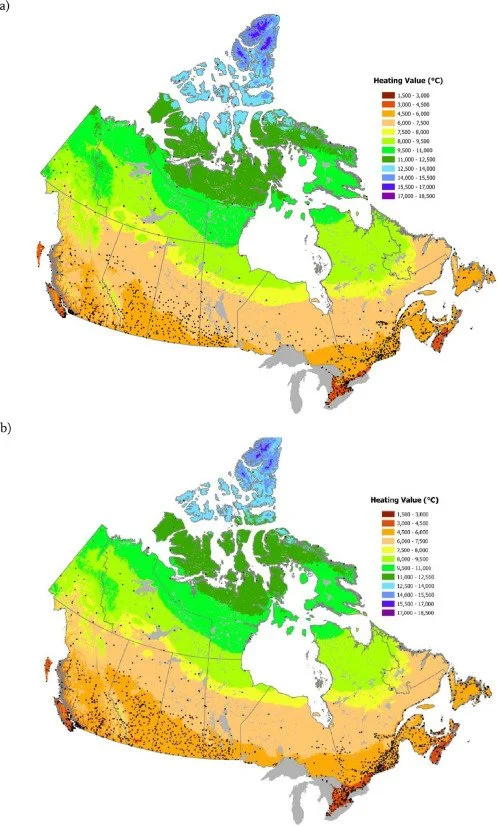
Fig. 1. Heating Degree Days for the 1951–1980 (a) and 1981–2010 (b) periods. Black dots show locations of meteorological stations used to develop the thin plate splines.
MacDonald, Heather, John Pedlar, Daniel W. McKenney, Kevin Lawrence, Kaitlin De Boer, and Michael F. Hutchinson. 2023. “Heating Degree Day Spatial Datasets for Canada.” Data in Brief 49:109450. https://doi.org/10.1016/j.dib.2023.109450.
Click here to read more.
The MacDonald et al. (2023) HDD dataset is now available through Canada1Water.
What: Development of Heating Degree Day (HDD) spatial datasets for Canada, covering two 30-year periods (1951–1980 and 1981–2010). These datasets were generated using daily temperature observations from Environment and Climate Change Canada (ECCC) and interpolated using thin-plate spline models to create high-resolution geospatial grids (~2 km resolution).
Why: HDD datasets provide a standardized measure of heating energy demand, supporting analyses of climate change impacts, energy consumption trends, and policy updates. These datasets were developed to inform decision-making on heating cost estimates, tax credits for northern and isolated communities, and long-term energy planning. By providing historical heating demand trends, the dataset supports energy forecasting and climate adaptation efforts across Canada.
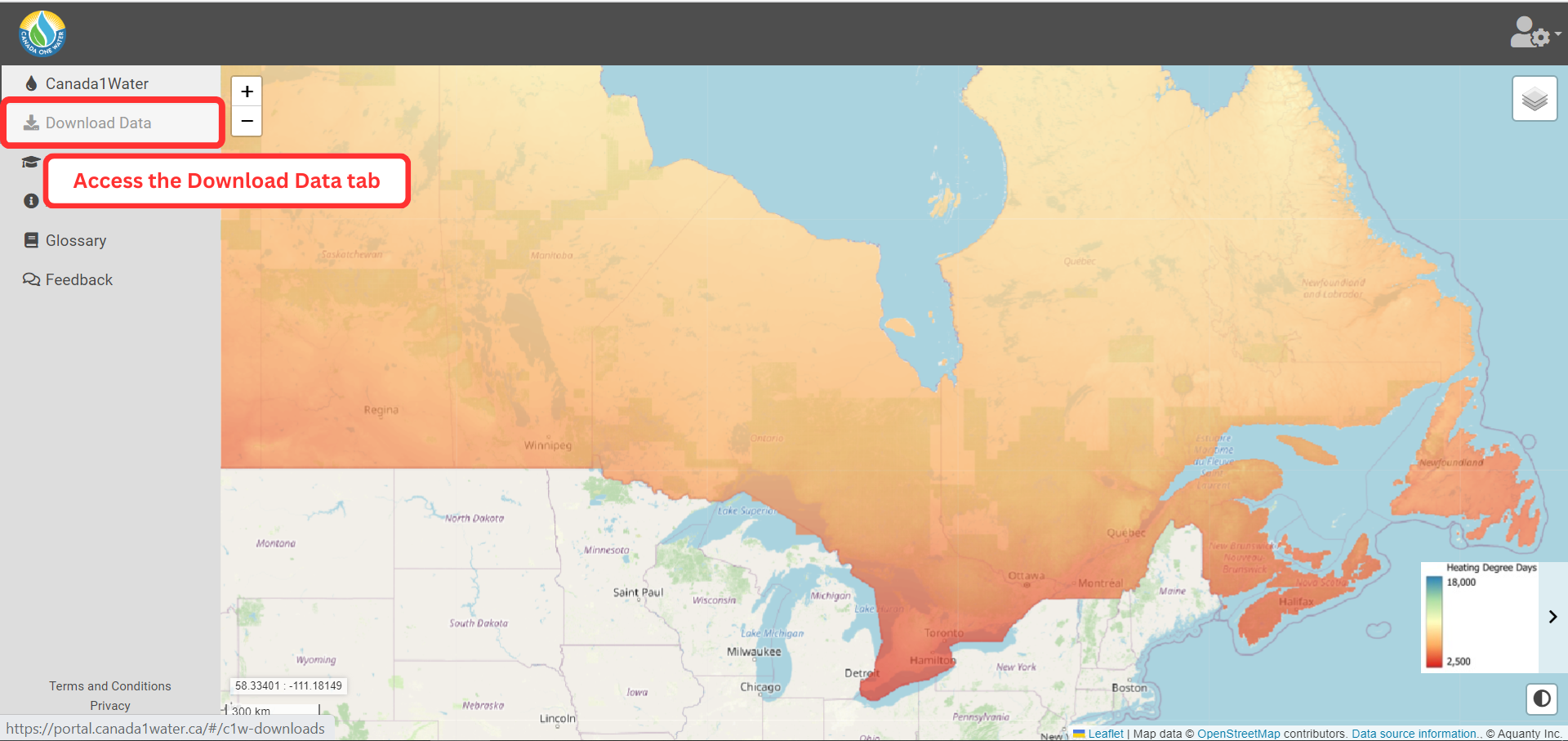
Step 2) Open the ‘Download Data’ tab in the navigation center.
Downloading the Data
Step 1) Log in to the C1W Data Portal
Canada1Water datasets are available for download through the C1W Data Portal. Click here to access the portal.
Step 2) Navigate to the “Download Data” tab

Step 3) Select a data product and download the data.
The ‘Download Data’ tab can be accessed by clicking on the menu item to the left of the screen.
Step 3) Scroll to the “Climate” data menu, expand the list and select which data product to download
Climate datasets are provided as vector/shp files, and provide full (i.e. continental) coverage over the indicated time period.